Factories
Industrial workwear colour coding: What each colour should mean on your floor
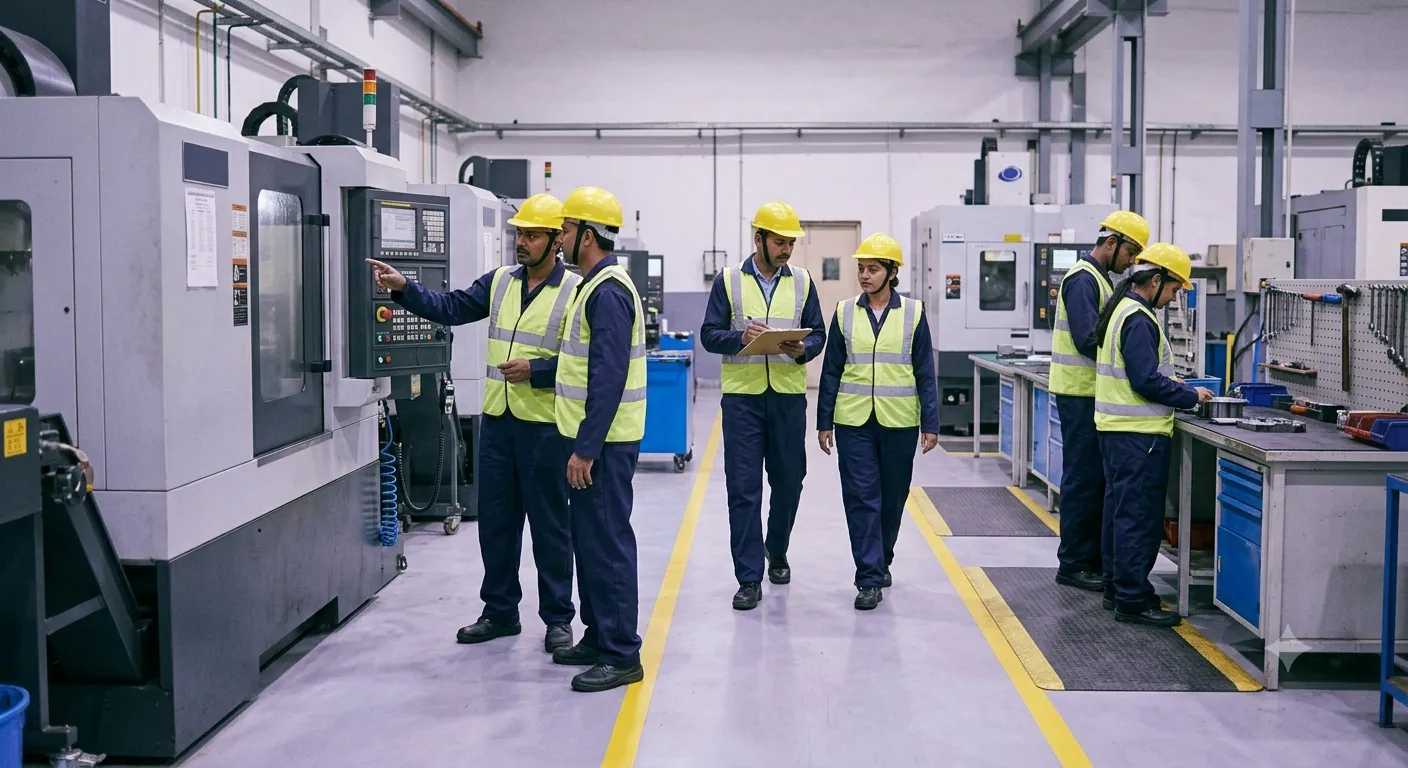
A plant that colour-codes helmets but not uniforms has half a system. Someone glancing across the floor should be able to tell role and access level from the uniform alone, at the same distance they’d read a helmet colour, and the two schemes should agree with each other rather than run two different conventions side by side.
This is for plant heads and safety officers specifying industrial uniforms in bulk who already have, or are building, a colour-coded helmet scheme and want the uniform to match it.
Colour by role: a scheme that tracks the helmet convention
Use the same colours the site already assigns to helmets, so a visitor reads one signal rather than cross-referencing two:
- White or light grey — engineers, supervisors, managers, and visiting officials. The formal-floor colour.
- Blue — technical and electrical staff, and supervisors on some sites.
- Yellow or khaki — general labour and civil work crews.
- Green — safety officers, and often new joiners under supervision for their first weeks.
- Red or a distinct high-visibility trim — fire and emergency response teams, kept unambiguous from every other role.
Keep this consistent with your helmet colour scheme rather than inventing a second convention. Two schemes that disagree on what “blue” means is worse than one scheme, because it trains staff to ignore the signal.
The distinction most schemes miss: contractor vs. permanent staff
Large plants run permanent staff and contract labour side by side, often from different agencies, and a colour scheme that doesn’t separate them loses one of its most useful functions: knowing at a glance who’s on the payroll and who’s on a contract, which matters for access control and for accountability during an incident. A common approach is a distinct piping colour or a contrasting collar on the contractor uniform, keeping the base colour the same as the role it maps to.
High-visibility roles sit outside the role-colour scheme
Crane operators, forklift drivers, and anyone working near moving vehicles or overhead loads need high-visibility clothing to IS 15809 regardless of what their role-colour would otherwise be. Treat hi-vis as an overlay — a vest or jacket in fluorescent orange or yellow-green worn over the role-coloured uniform — rather than replacing the role colour entirely, so both signals (who they are, and that they’re near moving equipment) stay visible at once.
What to document
A colour scheme that exists only as a habit on the floor doesn’t survive a change of safety officer or a multi-site rollout. Write it down:
- The colour assigned to each role, with a physical swatch or Pantone reference on file, not just a colour name.
- Where hi-vis overlays apply, and which IS 15809 class.
- The contractor-vs-permanent distinction, if you use one.
- Display the scheme at the gate and in the safety induction material, and use the identical scheme across every site under one company, so a transfer between plants doesn’t require relearning the colours.
How we supply colour-coded industrial uniforms
We supply industrial uniforms across the full role-colour scheme, matched to your existing helmet convention where one exists, from 50 pieces per order.
- Colour reference held on file against your account, tied to your helmet scheme if you supply one.
- Contractor and permanent-staff variants produced from the same fabric lot.
- Hi-vis overlays to IS 15809 quoted alongside the base uniform.
- Documentation supplied for your safety induction material and audit file.
If you’re setting up or extending a colour-coded uniform scheme, the form below reaches our sales team. Quotes go out within 24 hours, and we work from 50 pieces per order.