Safety & PPE
Safety helmet manufacturer and supplier: IS 2925, ISI marking, and what an auditor asks for
A safety helmet is the cheapest item in a PPE programme and the one an auditor picks up first. It is also the item most often bought from whoever quoted lowest, with no paperwork attached to the invoice.
This guide is for safety officers, plant heads, and procurement teams buying industrial safety helmets in bulk for factories, plants, and construction sites.
IS 2925 is the standard, and it is not the rider helmet standard
Industrial safety helmets in India are specified under IS 2925. It covers helmets for construction, mining, tunnelling, quarrying, shipbuilding, and general industrial work.
IS 4151 is a different standard, covering protective helmets for two-wheeler riders. It applies to your delivery riders and fleet drivers, and it is not interchangeable with IS 2925. A rider helmet issued on a construction site is a non-conformity, and so is an industrial hard hat issued to a rider. Buyers conflate the two because both carry an ISI mark, and the mark alone does not tell you which standard was applied.
Always confirm which standard number appears on the product and on the test report. Any IS 2925 helmet supplier should state it on the quotation without being asked.
| IS 2925 | IS 4151 | |
|---|---|---|
| Covers | Industrial safety helmets (hard hats) | Protective helmets for two-wheeler riders |
| Hazard modelled | Falling object, overhead impact | Road collision |
| Worn by | Plant, site, warehouse, facility crews | Motorcyclists |
| Accepted in a factory safety audit | Yes | No |
Specifying IS 4151 for a shop floor is the single most common helmet specification error, and it fails the audit rather than the wearer.
What the ISI mark actually certifies
The ISI mark is not a quality opinion. It is a statement that the product is manufactured under a valid BIS licence against a named Indian Standard, subject to BIS conformity assessment.
Three consequences that matter at the purchase stage:
- The mark is tied to a licence number. Ask for the licence number, and check that the standard on it is the one you need.
- The mark belongs on the product. Marking on the carton alone is not sufficient evidence. The helmet itself must carry identifying information, including the standard reference and the manufacturer’s identification, permanently marked.
- A mark is not a test report for your batch. Ask for the documentation covering the consignment supplied to you, not a generic certificate.
What IS 2925 tests
Useful to know, because it tells you what to inspect on the sample:
- Shock absorption — how much of an impact the helmet transmits to the head.
- Resistance to penetration — whether a striker reaches the headform.
- Flammability of the shell, and electrical insulation where that class applies.
- Harness and chin strap performance, including the strength of the attachment points.
Shell, harness, and chin strap
A helmet is three components, and buyers usually only specify the first.
- Shell — the moulded outer. Check the material, the presence and position of ventilation, and that the marking is legible and permanent, not a sticker.
- Harness or cradle — the internal suspension that holds the shell away from the skull and distributes an impact. This is what actually does the protecting. Check the number of anchoring points, the adjustment mechanism (ratchet adjustment is easier to fit correctly than a pin-lock slider), and whether the sweatband is replaceable.
- Chin strap — the component most often removed by workers, which makes its comfort a safety issue rather than a preference. Specify what you need before quoting, because retrofitting is not practical.
Ask whether harnesses and sweatbands are available as spares. A helmet whose harness cannot be replaced is one you will discard early.
Colour coding by role
Site colour coding is a convention, not something IS 2925 mandates. That means you set it, and you must document it.
A common Indian site scheme:
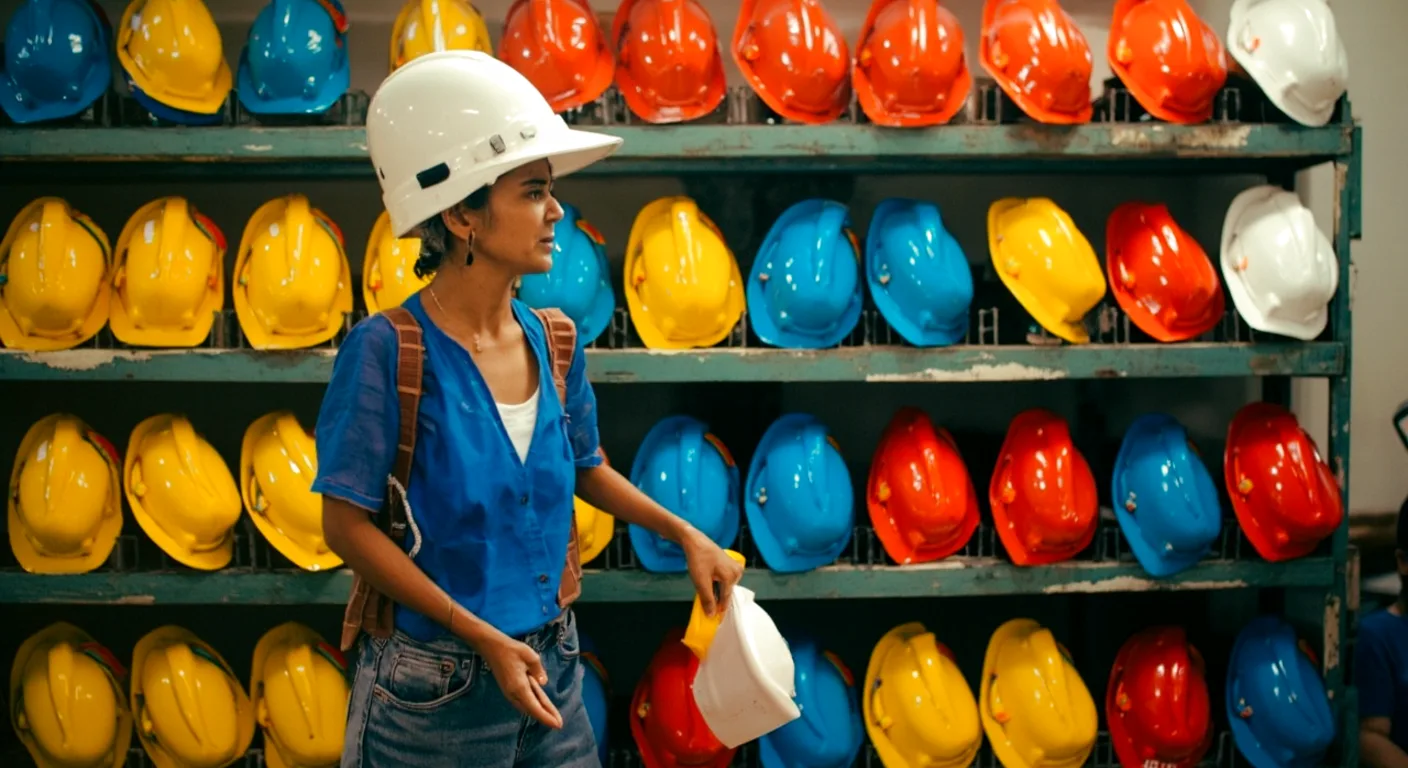
- White — engineers, supervisors, managers, visiting officials.
- Blue — technical and electrical staff, supervisors on some sites.
- Yellow — general labour and civil workers.
- Green — safety officers and, on many sites, new joiners under supervision.
- Red — fire and emergency response.
Whichever scheme you adopt, write it into your safety plan, display it at the gate, and use the same colours across all your sites. Two sites with different meanings for one colour is worse than no scheme. Coordinate it with your workwear and PPE issue so helmet and uniform tell the same story.
Replacement cycles
Helmets degrade whether or not they are struck. Ultraviolet exposure embrittles the shell, and sweat and adjustment cycles wear the harness faster still. The policy that holds up in an audit:
- Follow the manufacturer’s stated service life, which is marked on or inside the shell along with the date of manufacture. Do not substitute a general rule for what the maker states.
- Withdraw any helmet after an impact, regardless of visible damage and regardless of age.
- Withdraw on visible damage — cracking, chalking, deep scratching, or a shell that has lost its gloss.
- Replace harnesses and sweatbands on their own cycle, more frequently than shells.
- Record every issue and every withdrawal against the employee.
The audit file
Keep this against each purchase order:
- The BIS licence details for the model supplied.
- Test documentation naming IS 2925.
- Invoice with a batch or lot reference tying back to the report.
- Your written colour-coding scheme.
- Issue register signed by each employee.
- Withdrawal and replacement log.
How we supply helmets in bulk
We supply industrial safety helmets, safety footwear, and PPE to plants, construction sites, and facility and site contractors across India, from 50 pieces per order upwards.
Our process:
- Standard and specification confirmed on the quotation before the order.
- Sample approved before bulk release.
- Colour scheme and quantity split agreed by role.
- Per-piece pricing in writing, locked for the order.
- Documentation supplied with the consignment for your audit file.
- Scheduled replacement drops on a rate contract.
If you are a safety officer or procurement lead sizing a helmet order, the form below reaches our sales team. Quotes go out within 24 hours, and we work from 50 pieces per order.