IT & Corporate
Polo t-shirt manufacturer for corporate, security, and hotel teams
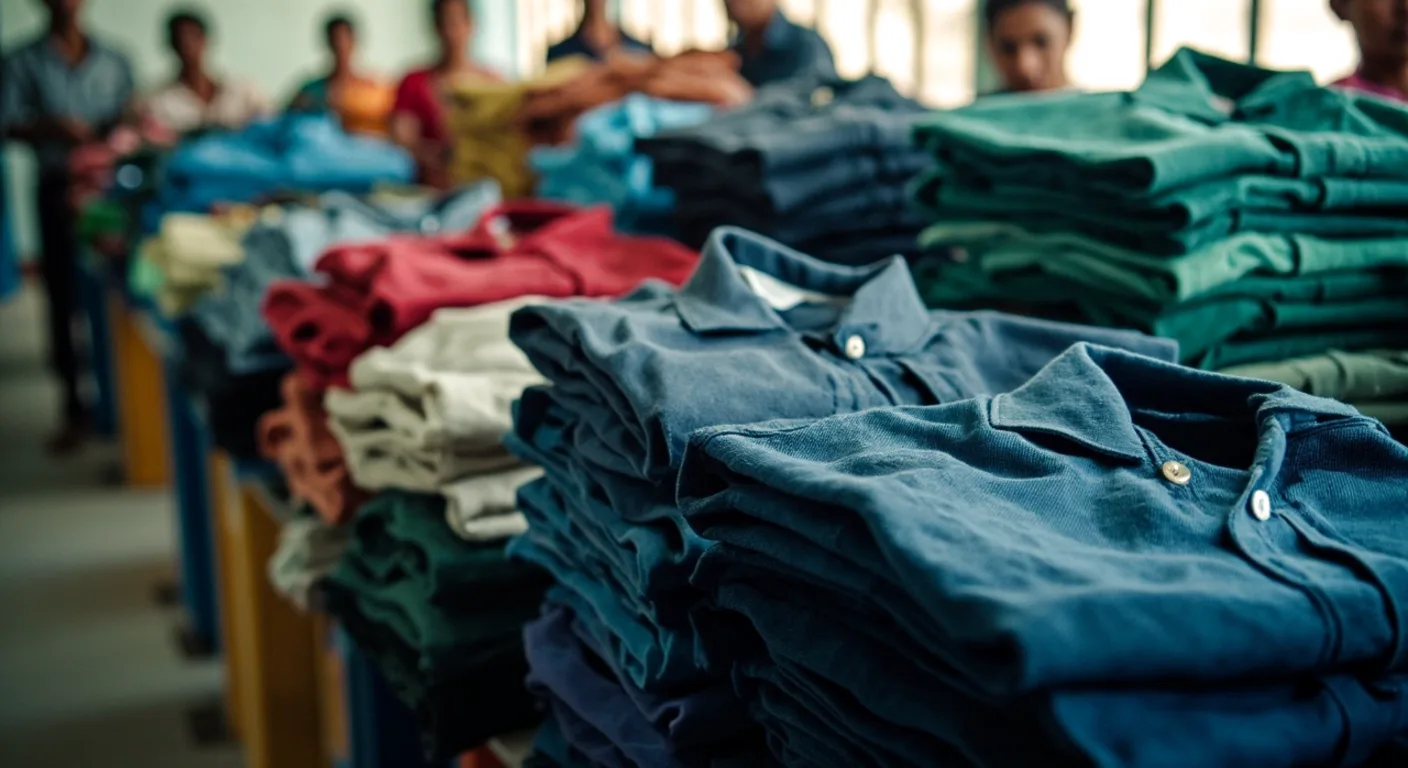
A polo sits between a t-shirt and a formal shirt, which is why it has become the default working garment for so many Indian teams. It is presentable enough for a guest-facing role and comfortable enough for a twelve-hour shift.
It is also the garment where quality differences are most visible after three months. A round-neck t-shirt ages evenly. A polo ages at the collar, and a curled collar makes an otherwise clean uniform look neglected.
This guide is for HR, admin, and operations teams ordering polo t-shirts in bulk.
The collar is the whole decision
Two construction methods, and the difference is not cosmetic.
Cut-and-sew collar — cut from the same knitted fabric as the body and stitched on. Cheaper, and the standard on low-cost promotional polos. It relaxes and curls at the points within a few dozen washes, because the fabric was never engineered to hold a shape at an edge.
Knitted or tipped rib collar — knitted separately as a finished panel with a bound edge, then attached. Holds its shape through repeated washing, and is the reason a two-year-old polo can still look presentable.
For anything worn daily by a guest-facing team, specify a knitted rib collar. For a one-day event polo, cut-and-sew is a reasonable saving. Also worth fixing on the sample:
- Collar interlining or fusing at the stand, which keeps the collar upright rather than flopping.
- Tipping — a contrast stripe at the collar and cuff edge. Effective for role coding, but it must be knitted in, not printed on.
- Side vents and a taped shoulder seam, both of which reduce the way a polo distorts across the shoulders over time.
Placket detail
The placket is the short button opening at the front, and it is where cheap polos give themselves away.
- Button count — two or three. Three reads slightly more formal; two is more common for security and field teams.
- Placket construction — a separately cut and stitched placket holds flat. A folded-over self-placket puckers.
- Buttons — specify the material and ask for spares to be supplied with the consignment. Button loss is the most common in-service repair and the easiest to plan for.
- Interlining inside the placket, which stops the front from rolling.
Fabric weight for daily wear
Polos are usually knitted in pique — a textured knit that breathes better than jersey and hides creasing.
- 180 to 200 GSM pique — the working band for daily-wear corporate and hospitality polos. Structured enough to hang properly, light enough for Indian conditions.
- Below 180 GSM — acceptable for events and giveaways, not for a garment issued as a uniform.
- Poly-cotton pique — the practical choice where the garment goes through commercial laundry. Holds shape, resists shrinkage, dries fast.
- Dry-fit polyester pique — for outdoor roles and warm, high-movement work.
A branded polo t-shirt supplier quoting a daily-wear uniform below 180 GSM is quoting a different product than the one you are buying.
Colour-fastness after industrial laundry
This is the specification that separates a hospitality order from a corporate one. A hotel or resort polo goes through commercial washing with hot water and strong detergent, several times a week. A head-office polo goes into a domestic machine once a week.
What to check before bulk release:
- Wash the approved sample the way the garment will actually be washed, at the temperature and detergent your laundry uses. Not a domestic test wash.
- Look for shade change on the body, and separately for shade change at the collar and cuff, which fade first.
- Check for crocking — colour rubbing off onto other fabric — on dark shades, particularly navy and black.
- Check dimensional change. A polo that shrinks in length but not in width becomes unwearable.
- For housekeeping and facility teams, test against bleach exposure, since it will happen whether or not it is policy.
Deep shades and reds are the most demanding. If a supplier will not run a wash trial on the sample, that is the answer to your question.
Role-based colour coding
Colour coding is the reason many operations move to polos in the first place. It lets a supervisor identify a role across a floor without reading a badge.
A workable scheme:
- Assign colours by function, not by seniority. Seniority changes; function does not.
- Keep the palette small. Four or five colours is legible; nine is not.
- Use tipping or a contrast collar for a sub-role rather than adding another body colour.
- Record the scheme in writing and against the supplier’s account, so a re-order in eighteen months returns the same shades.
- Keep it consistent across sites. A colour that means one thing at one location and another elsewhere defeats the purpose.
The same logic runs across corporate and multi-site teams, where a single scheme has to hold across offices.
How we supply polos in bulk
We supply corporate, security, hospitality, and custom branded polo t-shirts across India, from 50 pieces per order upwards.
Our process:
- Collar construction, placket, and GSM fixed on the quote.
- Stitched and decorated sample before bulk release.
- Wash trial matched to your actual laundry conditions.
- Colour scheme recorded against your account for re-orders.
- Per-piece pricing in writing, locked for the order.
- Multi-location delivery from a single purchase order.
If you are specifying polos for a corporate team, a security deployment, or a hospitality property, the form below reaches our sales team. Quotes go out within 24 hours, and we work from 50 pieces per order.